The Esoteric Ebb Effect
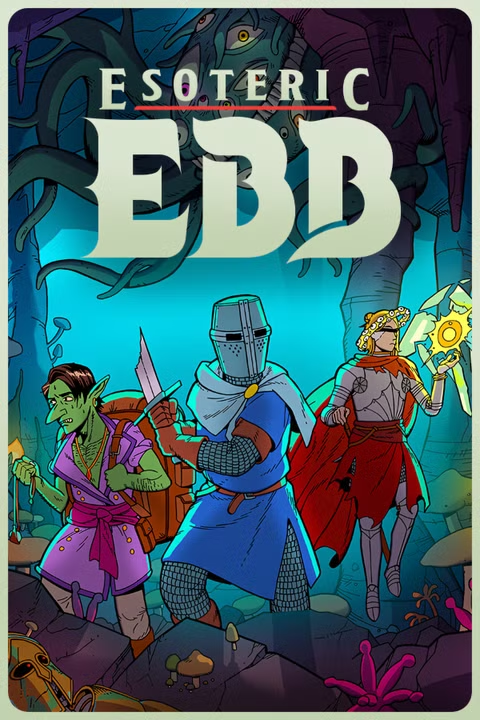
It is set in a weird-fantasy city called Norvik, that is one week away from it’s first democratic election.
What is it about?
You are an arcane cleric who just died yesterday, were resurrected in a lighthouse surrounded by apples (a LOT of apples) and do not remember a damn thing.
After you get your bearings and try to talk with a zombie and almost get eaten by a crate full of sand you get to meet a lot of interesting people that have opinions, secrets and QUESTS. (yes you like those quests, don’t you?)
You quickly learn the main two plot lines guiding you through the game are the mysterious explosion at a teashop, that you apparently were tasked to investigate and the upcoming democratic election. (are there maybe some connections?)
With these two things in mind and only one week left until the election takes place (you need to solve the mystery by then) you get up to explore the city Norvik in small detailed areas with a handful NPCs in each area to talk to.
But there is a catch: Time. Every line of dialogue you select ticks the clock forward. Most of the time only 1 minute but sometimes even 10, 30 or 60 minutes. So you need to hurry or you don’t. It’s up to you how you want to go about this. It’s your story.
Why did I like it?
Esoteric Ebb has a funny, sometimes stereotypical sense of “D&D humor” which I came to appreciate.
Like in Disco Elysium your character also has inner voices, that originate from the six core stats: Strength, Dexterity, Consitution, Wisdom and Intelligence.
Unlike Disco Elysium, I really like their individual personalities and voices because every attribute also has a political identity (kind of funny) that try to sway you constantly.
Other than that you also use those attributes like you would in D&D and roll dice. Esoteric Ebb therefore feels like playing D&D in a very distinct fantasy homebrew world with deep history and lore that you get to know during your playthrough and the world feels like it already existed centuries before you dive in, even though you only see a glimpse of it.

Everything feels like a little glass pebble at the right place in a giant fantasy mosaic that wants to be discovered by you.
In contrast to official published settings like the Forgotten Realms, you do not need a whole 200+ page book to understand why the world became the way it is. You learn it by the disposition, thoughts and actions of the characters involved or by simple investigating items or ancient artifacts if your Intelligence is high enough.
But what really inspired me was the way this world handled magic in an Era right after the last Arcanists fell in a presumably world-wide war.
Magic is lost in this world and normal people cannot cast magic. Even a third-level spell is a rarity in the current days and everything above sixth level is mystical stuff of ages long past.
What did inspire me?
So there are two examples I want to give on why I like the thought and representation of magic in Esoteric Ebb. Even though it has an unique approach how magic works by tucking Jor’s String instead of Mystra’s Weave I really got inspired by more concrete revelations.
A Resurrected Victim
Not long after you leave the lighthouse where you came to life again, you meet a small imp called Braxo who is a barrister and specialist for legal advice.
When talking to him you can ask a question that may have some relevance to you:
What happens to a murder charge when the victim was resurrected?
I don’t really remember the answer, but it may have been a funny one. The more interesting part is the question itself, because what does it mean for a criminal charge, when the actual victim is no longer a victim?
Weapons of Mass-Destruction
During the Arcane Era the Arcanists mass-produced a magic weapon to defend their supremacy: Necklace of Fireballs (also called NOF in Esoteric Ebb)
These weapons were used by artillery corps and flights bombers during the Coastal War, but they were also used by assassins and terrorists even after the war ended.
To this day there are still new caches found and Reeds, where most of the remainders are found, has special laws on how to deal with them.
For someone who lives in Eastern Germany where old WWII bombs are unearthed occasionally during construction work even today, this history behind NOF’s seemed very familiar to me. (even though NOFs are more portable and concealable than aerial bombs of WWII)
My inspiration
Thinking about our real-life ideologies, societies and laws but through a lens of a fantastical world where magic is real can open up new ideas on how we can make our own homebrew worlds feel more real.
It got me thinking about how does magic impact a world where it exists in abundance.
In the past I mostly viewed the PC’s as adventurous heros that are very special in a medievally european inspired world, but a high-fantasy world where only a handful individuals even can cast magic seemed kind of weird to me.
So what if there were people that can cast Prestidigitation to clean almost all things?
What does it mean for legal processes about murder convictions if you can Speak with the Dead?
Who profits the most when you can conjure up Goodberries that provide enough nourishment for a person a day? Who has something against feeding a lot of people?
And how might a city be designed if you know there could be Fireball-armed protestors in the streets?
I think by answering these kind of questions a fantasy world will come more to live and players might feel an immersive sense of familiarity when presented with such a world.
A lot of things came to my mind after I realized that this might be something I was missing from my worlds the whole time and I wanted to train this creative muscle but first I needed a name for this kind of concept.
The name I decided on was Spell Ecology.
About Spell Ecology
The initial idea
After my initial realization I started to note down all the topics regarding spell’s impact that interested me. The list I came up with was unordered, had some redundancies and frankly was too much at once.
It looked like this:
- People & Groups - Who in a society would use it and how?
- Business & Services - What kind of economical, federal or altruistic Services could be associated with this spell?
- Socio-Economic Consequences - What consequences would this have on a society and which problems we may have in the real world does the spell solve?
- Schemes, Conspiracies & Criminals - How could this spell be used in criminal activites and who would use it?
- Magic Items & Loot - How and where could this magic spell be found and in which form?
- Places, Origin & Variations - Where did this spell come from, who created it and what may be alternative variants that exist in the world? (evolution of a spell)
I knew I wanted to make the idea of Spell Ecology into a creative habit and it is also why I started this blog, so I needed to refine it into a more concise framework to make it more usable and understandable.
The refinement
I took this list to our AI Overlord ChatGPT and after a thorough conversation with the machine I had consolidated these bunch of topics into 6 distinct themes lovely named The Spell Hex
1. Society
- People, groups, institutions
- Core idea: Who relates to this spell?
- Questions:
- Who depends on this spell the most?
- Who fears, resists, or opposes this spell?
- What organization, culture, or social role formed around it?
2. Economy
- Business, services, labor
- Core idea: What does this spell do to work?
- Questions:
- What profession or service exists because of this spell?
- What job, industry, or resource becomes less valuable because of it?
- Who profits most from controlling access to this spell?
3. Systems
- Consequences, societal change, problem-solving
- Core idea: What changes at civilization scale?
- Questions:
- What major problem does this spell effectively solve?
- What unexpected consequence emerges from widespread use?
- What law, norm, or institution had to adapt because of it?
4. Conflict
- Crime, schemes, conspiracies, exploitation
- Core idea: How is this magic used for wrong doing?
- Questions:
- How is this spell abused, weaponized, or exploited?
- Who uses this spell secretly or illegally?
- What conspiracy, underground trade, or conflict formed around it?
5. Artifacts
- Loot, material culture, magical objects
- Core idea: How does this spell become tangible?
- Questions:
- In what object, place, or form is this spell commonly found?
- What magical item or mundane tool emerged from this spell?
- What rare or legendary version of this spell exists as treasure?
6. Legacy
- Origin, evolution, variants
- Core idea: Where did this spell come from?
- Questions:
- Who first created, discovered, or popularized this spell?
- What forgotten, regional, or forbidden variation exists?
- How has this spell evolved or changed across cultures or history?
The machine also proposed a nice visualisation for the Spell Ecology Hex which looks like this:
                    ◇ LEGACY
              "Where did it come from?"

      ◇ ARTIFACTS               ◇ SOCIETY
    "How is it tangible?"    "Who relates to this?"

                      ✦ Spell ✦
                Level # Spell School
              "short spell description"

      ◇ CONFLICT               ◇ ECONOMY
  "What wrong is done?"      "What does it to work?"

                    ◇ SYSTEMS
          "What changes at civilization scale?"
Conclusion
Playing Esoteric Ebb inspired me by how the world-building rationalizes magic and spells and their impact on said world.
I found that Spell Ecology might be something I was always missing from my fantasy TTRPG games.
To train my creative muscle and improve my world building I want to utilize the idea of Spell Ecology.
So in the future from now on as a creative thinking exercise, I am going to create a Spell Ecology Hex for each spell of the 5e SRD post by post and see what my imagination can come up with (without using AI of course).
This was the Esoteric Ebb Effect on me.
Stay tuned for more about Spell Ecology!